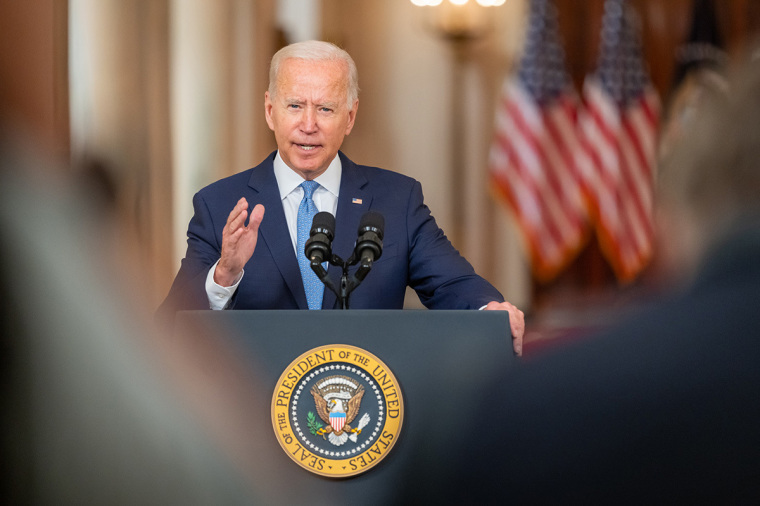
President Joe Biden delivers remarks on ending the war in Afghanistan, August 31, 2021, in front of the Cross Hall of the White House. | White House/Adam Schultz
President Biden’s grandiose Build Back Better plan seeks to expand the size and scope of the federal government to a degree not seen since Johnson’s Great Society. But mention any limits to the power of government and people on the left and right bare their fangs. If they were porcupines, they would raise their quills. Most people assume that the state must have absolute power, or we will kill and eat each other.
God disagrees. Let’s look at the most famous passage on government in the New Testament, Romans 13. Paul launches the discussion with what appears to be an absolute command:
“Let every person be subject to the governing authorities. For there is no authority except from God, and those that exist have been instituted by God.”
Verse four continues,
“For he is God’s servant for your good…”
Few theologians read past the first half of verse four and conclude that God has written a blank check to governments to do anything they desire if someone views it as good. They employ the first half of verse four to justify setting minimum wages and maximum prices, providing healthcare, welfare and education, building roads and airports and many other activities.
However, the second half of verse four reads, “…He is the servant of God to execute wrath on the wrongdoer.” That sentence gives us a clue as the role God thinks government should play – to punish evil people.
The great political theologian Oliver O’Donovan wrote in his book, Desire of Nations, that Paul had pruned the role of government back to its original one of punishing evil because the Father had given Christ all authority, as he said in Matt. 28:18, “All authority in heaven and earth has been given to me.”
Statists of the left and right bristle at such a suggestion and argue that Paul is merely giving us one of the many jobs of government, not all them. Specifying some activities of the state doesn’t exclude it from engaging in others. If authority is a public good, like air, so that my use of it doesn’t diminish yours and both could have as much as we wanted, then critics of O’Donovan would be right.
But authority isn’t a public good; it’s a private one. Competing authorities is a zero-sum game like poker in which the winner of a hand takes money from the losers. The one who has power over me diminishes my power. If I take back that power, I diminish his. An officer in the military has power that the enlisted men under him don’t. He has reduced their power to act. If they rebel and take back some of that authority, the officer loses what authority he had.
Paul wrote in Romans 13 that governing authorities are servants of God. The Greek word is the same as the one for deacon. Governments have no authority but that given to them by God. He assigned government the role of punishing evil people, those who violate the God-given rights to life, liberty and property of others. If the state takes on more roles, it steals the authority from God and from citizens.
And the state’s role is even more limited because the state has no money of its own. All it has comes from taking the property of others through taxation. The state diminishes the wealth of individuals to perform its God-given duty. God has given the state the authority to tax people to perform its role. Jesus said to give to Caesar what belongs to him (Luke 20:25). Paul confirms it in Romans 13:6 and Peter agrees in I Peter 2:19.
But for the state to expand its role beyond that of punishing evil, it must take more of the people’s wealth to pay for it. As with authority, it must reduce the wealth of citizens to expand its role and in doing so conflicts with citizens’ right to property. “Thou shalt not steal” applies to governments as much as citizens. At what point does taxation become theft?
Statists argue that under a democracy the government cannot steal because the people give their consent to the taxes. But God never said, “Thou shalt not steal unless the majority approves of the theft.” Individuals have rights to life, liberty and property that the state cannot infringe upon. The right to life is the positive restatement of “Thou shalt not murder.” The right to property is the positive of “Thou shalt not steal,” including the government. If the state steals from its citizens, then democracy becomes the tyranny of the majority.
Wealth is limited, so if the state wants more of it to perform roles other than its God-given one, it must take wealth from citizens who have the right to it. It must increase its authority and wealth and reduce those of individuals. But who gave the state the authority to do so?
The theologians at the University of Salamanca, Spain, during the Reformation arrived at the principles of limited government centuries before O’Donovan. They determined that the state has no authority beyond that to punish evil people. God had given individuals the rights to life, liberty and property and the people contracted with the government to protect those rights because they understood the benefits of specialization before Adam Smith. John Locke learned his contract theory of government from those scholars. If the state goes beyond its God-given duties and raises the necessary taxes, it commits theft.
This argument won’t convince statists because they love the state and most pick a verse from the Bible, plant a flag on it and camp there. They read, “Let every person be subject to the governing authorities” and stop. They ignore the principles of hermeneutics that instruct us to consider all verses on a topic to distill systematic theology about it. Good systematic theology is hard work, and few people want to do it.
The theologians of Salamanca and Oliver O’Donovan have done the hard work for us. Whether we like it or not, God in the Bible has given the government a very limited role, that of punishing evil people and nothing more. The Magna Carta and the U.S. Constitution instantiate that principle.
A strong argument against Biden’s Build Back Better leviathan is that it is illegal under the Constitution and violates God’s role for government.
Alexandria Ocasio-Cortez and Aurora James attend The 2021 Met Gala Celebrating In America: A Lexicon Of Fashion at Metropolitan Museum of Art on September 13, 2021 in New York City. | Getty Images/Mike Coppola
Conservatives laughed at celebrity representative Alexandria Ocasio-Cortez, D-New York, attending the Met Gala recently. Tickets were reported to cost $35,000 each. But the representative didn’t pay for her ticket; she was a guest and she borrowed her dress. She said she attended in order to send a message to the country’s wealthiest people.
Voters, and the owner of the dress, should be concerned about the message she painted in scarlet letters on the white gown, “Tax the Rich.” Socialists like AOC are about 400 years behind the times in their view of the rich. They see the rich as having hoards of gold in a bank or secure room in one of their mansions that they amassed by cheating others who are poorer as a result.
AOC’s understanding of the rich was accurate from prehistory until the advent of capitalism in the 17th century. Through most of history, the “honorable” ways to get wealth if you didn’t inherit it was through plunder in war, kidnapping for ransom and doing favors for the king, who would steal the land of an enemy and give it to you. Or the king might give you a monopoly on trade in some commodity like silk so that you could charge exorbitant prices.
Often, the nobility would steal the wealth of common people by bribing judges to find the owners guilty of false charges. The commoner would be executed, and the “noble” person would get the wealth, usually land. Old Testament prophets complained about that practice in ancient Israel, and Jerry Bowyer demonstrates in his book The Maker Versus the Takers: What Jesus Really Said About Social Justice and Economicsthat most of the wealthy in Judah had gained their wealth by immoral means.
Few grew wealthy through commerce. Pagan philosophers such as Aristotle considered commerce to be morally lower than prostitution. Theologians baptized that pagan philosophy rather than dig out of the Bible a doctrine of economics and commerce. That’s why Christian Europe refused to allow Jews to work in government or serve in the military and consigned them to commerce and banking, the most despised professions. When Jews would become wealthy, Christians would fabricate charges against them as an excuse to steal it.
Nothing changed until the Godly theologians at the University of Salamanca, Spain, distilled the principles of capitalism from the Bible and the Dutch Republic implemented them. The Dutch outlawed the traditional ways of gaining wealth and prevented the nobility from stealing. They left hated commerce as the only path to wealth.
So, AOC is wrong. Most wealthy people for the past four centuries have earned it through commerce by serving the people better than their competitors. Rarely do they keep much of their wealth in gold. Most of it is tied up in their businesses. However, a few have grown wealthy by bribing politicians to legislate favors for them as they did before capitalism.
The mostly likely cause of AOC’s and the left’s hatred of the rich is pure envy. The left loves to toss around accusations of greed, but they never mention envy, except as a joke, “I envy your new Lexus!” But as Helmut Schoeck showed in his classic book Envy: A Theory of Social Behavior, envy used to be considered the worst of the seven deadly sins because of its destructive power.
An old European story depicts envy well. An angel visited a peasant and offered to grant him a wish. The peasant thought a minute and said, “Well, my neighbor has a milk cow and I don’t.” The angel said, “So, you want me to give you a cow?” “Heavens, no!” cried the peasant. “I want you to kill my neighbor’s cow.” The peasant didn’t want others to envy him for having a cow in the same way he envied his neighbor.
Here’s another: An angel offered to grant one wish to a peasant, who imagines the treasures he should request. But the angel explained that whatever the peasant received, his neighbor would receive double. The peasant says, “Ok, then I want you to poke out one of my eyes.”
Those stories show the destructive nature of envy. The envious person doesn’t want to improve his position in life; he wants to bring someone else down to his level. The popular French economist Thomas Piketty, who is Professor of Economics at the School for Advanced Studies in the Social Sciences, in his book Capital in the 21st Century said as much when he admitted that his proposal for an 80% tax on wealth would bring in little revenue to the government, but it would impoverish the wealthy.
Socialists have canceled envy, but Christians should resurrect it because the Bible condemns the sin of envy. Matthew 6:22-23 is an important passage. The New International Versions translates it as
“The eye is the lamp of the body. If your eyes are good, your whole body will be full of light. But if your eyes are bad, your whole body will be full of darkness. If then the light within you is darkness, how great is that darkness!”
However, a literal translation would read “…if your eye is evil…” This is a rendering of the ancient fear of the evil eye that is common outside of the West and through history. In the West we tend to call it “green eyed.” An evil eye is envy. Other verses that translate evil eye as envy are Matthew 20:15 and Luke 11:34.
According to Schoeck, envy kept people starvation-poor from prehistory until the advent of capitalism, when Christianity tamed envy enough to allow for innovation and economic development, but only in the West until the 20th century. Then, Christians in the West abandoned Christ and envy burst from its tomb. It stalks the world like a zombie disguised as socialism. Envy is the power behind socialism.
Unfortunately, a minority of evangelicals have had their brains eaten by the envy zombie and so promote socialism. The only defense is the power of Christ to suppress envy so that we love our neighbors, including the rich, as ourselves.
Taliban fighters sit on a vehicle along the street in Jalalabad province on August 15, 2021. | AFP via Getty Images
Washington thought Afghanistan was a fixer upper. But after spending trillions of dollars and thousands of lives trying to improve it, the messy capitulation has stunned and embarrassed Americans who want to know what went wrong. However, let’s ask another question about Afghanistan: why is it so poor?
Per capita gross domestic product (GDP) is the most common measure of standards of living used by economists. This year GDP per capita was $592 for Afghanistan, compared to $35,672 in the U.S. That makes Afghanistan one of the poorest countries in the world. Of course, we Boomers will remember that this poor country has been at war since Soviet armies were invited to rule in 1980. Over 40 years of war will tend to give a place a run-down appearance.
In the summer of 1976, I worked with others to smuggle Bibles into Afghanistan from Iran. Iran was poor by U.S. standards, and I had been to Mexico several times, but I had never witnessed the extreme poverty that I found in Afghanistan. Even in 1980, the per capita GDP was $273 compared to $12,575 for the US. None of these figures have been adjusted for inflation.
That doesn’t mean Afghanistan has no wealthy people. A tiny group of war lords and government officials are wealthy even by western standards. As with most poor countries, a tiny group of wealthy dominate a mass of nearly starving people. Why?
Some readers may have been convinced of the immorality of a minimum wage. Previous articles on it are here, here and here. Still, they worry about the consequences of not having one. After all, minimum wage laws affect only entry level jobs that require no experience or skills. Won’t the wages of the poorest workers collapse?
The question illustrates one of the most important principles of economics, what is seen vs. what is not seen, or the short-term vs. the long-term. The media and the public focus exclusively on the most visible aspects of any situation and rarely consider the broader impact that happens in the long term.
The great French economist Frederic Bastiat used the case of a broken window to illustrate the principle. The media focuses on the income that the window repairman will earn and see that as a good thing, but they fixate on the visible, short-term results of the tragedy. They miss the long-term, invisible consequences of the broken window, such as the money that might have gone to buy new shoes for the kids or a meal at a restaurant. The window repairman earns only what the shoemaker and restaurateur have lost. The media makes this error every time a major disaster destroys part of a city.
The single most asked question I get at investment conferences is, “Do you have a list of money managers who invest guided by the Austrian School of economics?” The question is a good one. After all, the Austrian School stands alone in predicting the fall of the Soviet Union and the housing and financial crash.
Anyone with a retirement account has been whipsawed by the stock market over the past few decades. Fidelity’s Peter Lynch told everyone to buy stocks and hold. Everything would work out great. Diligent savers would even end up millionaires, courtesy of an ever-expanding stock market. The efficient-market hypothesis (EMH) provided intellectual support for the idea. The market reflects all information, so there’s no way to beat it, said the economists.
Now everyone knows better. Or at least they should.
The average person’s 401(k) was turned into a 201(k) in 2000, and was destroyed again in 2008 if they were brave enough to stay or get back in the market. Many people swore off stocks after the last crash only to watch the S&P 500 triple. Now the Fed’s zero interest policy has pulled them back just in time for the next market train wreck.
Those educated in the Austrian School understand how the central bank creates the business cycle’s booms and busts. And they know there is a better way than just buying, holding, and hoping. But how does one apply it using Friedrich Hayek’s and Ludwig von Mises’ theories to make money in the market?
In a very readable 107 pages, Roger McKinney shows you how to turn theory into profit and financial survival in his book Financial Bull Riding.
Now is the perfect time to read McKinney’s book. Stocks are trading at all-time highs. More margin debt is outstanding than ever before. Price/earnings ratios are stretched, with market darlings like Netflix and Amazon trading at P/Es of 196 and 581, respectively.
However expensive it may be, if you’ve missed this market move, every day it goes up, you feel the regret and are tempted to jump in. If already fully invested, you’re rationalizing away any concerns.
Eugene Fama may have shared the Nobel Prize for his EMH work, but McKinney disposes of the idea using a folksy story from a serially successful investor — Warren Buffett — that strict adherents to EMH would deny the existence of.
Buffett finished his story about coin-flipping orangutans with “I think you will find that a disproportionate number of successful coin flippers in the investment world came from a very small intellectual village that could be called Graham-and-Doddsville.”
Common sense still makes sense in the plains.
Buffett has a point. Even in the speculative world of junior resource investing, the legendary Rick Rule is an ardent adherent to the teachings of Ben Graham and David Dodd.
McKinney’s book may be about beating the markets, but the author gains his clear perspective not just through the lens of Austrian economics but from operating as a financial adviser far, far away in the flatland of Oklahoma. His perspective isn’t clouded by the canyons of Wall Street. Common sense still makes sense in the plains.
Bull Riding is Rothbardian in its scope of history used to support the book’s premise. Richard Cantillon is not a household name, but McKinney provides a brief, enlightening history of the man who made a fortune in the crash of John Law’s Mississippi Bubble in 1720 France.
And how many books on investing mention the University of Salamanca as the beginning of the marginal revolution? “Had [Adam] Smith been more familiar with the writings of the Salamanca scholars, he would not have made that mistake.” “That mistake” being the labor theory of value.
Readers shouldn’t worry about the author getting too bogged down in theory or history. He condenses these matters, as well as the Keynesian takeover. He then quickly gets into explaining the Austrian business cycle theory as the bedrock for investment timing.
Hayek’s and Mises’ insight was that monetary intervention by a central bank forces interest rates below their natural rate. This fools entrepreneurs into believing savings have increased and demand has shifted from consumer goods to higher-order (investment) goods. Of course, savings haven’t increased, and this misdirected capital becomes what Austrians call malinvestments, to be liquidated in the downturn.
Selecting good companies to invest in is important, but timing is everything. “If we can predict with some accuracy when profits will change in the business cycle,” McKinney writes, “we should have some idea of when stock prices will change.”
The author follows the money and, in turn, the profits of various business sectors, providing a road map to help investors determine entry and exits points in the market. It’s what he calls avoiding the “business cycle horns.”
Investors have different temperaments and risk tolerances. Very few are all-around cowboys. McKinney lays out three strategies for this investment rodeo depending upon what kind of cowboy you are.
You may be a calf roper, with plenty of skill and, most importantly, plenty of patience. But calf ropers don’t make as much as other cowboys. Steer wrestlers make more, but timing is more critical, while less patience is required.
The big money in any rodeo is made by bull riders, who risk life and limb for an eight-second thrill ride. The investment bull rider will try to ride all market fluctuations using margin, options, and futures. Bumps and bruises should be expected, but the rewards can be enormous for a successful ride. Especially if you use Austrian business cycle as a big-picture guide, with technical analysis to navigate the market’s daily bucking.
The best freedom is financial freedom. Rather than hand your hard-earned savings to a broker or money manager whose primary interest is to generate commissions or increase money under management, take control of your own nest egg.
Popes normally stick to their bailiwick, faith and worship. But Pope Francis’s criticisms of capitalism came early and often, escalating since the beginning of the covid pandemic. The pontiff describes free market thinking as “magic theories.”
“The fragility of world systems in the face of the pandemic has demonstrated that not everything can be resolved by market freedom,” Francis wrote in his encyclical late last year. “It is imperative to have a proactive economic policy directed at ‘promoting an economy that favours productive diversity and business creativity’ and makes it possible for jobs to be created, and not cut.”
Roger McKinney doesn’t see eye to eye with the pope. In his book God Is a Capitalist: Markets from Moses to Marx, McKinney “shows how Biblical economic principles answer the most vexing problems the world faces today, such as poverty, inequality and pollution.”
While Pope Francis stumps for socialism, McKinney points out that the system Francis fancies has given us millions of deaths from the likes of Nazi Germany, Stalinist Russia, and Castro’s Cuba.
McKinney’s intellectual journey started with the so-called father of capitalism, Adam Smith, and Smith’s The Wealth of Nations. However, Smith didn’t address where capitalism came from, and McKinney discovered the work of the theologians at the University of Salamanca, Spain. He learned what Chinese intellectuals knew three centuries before: “God is a capitalist.”
As he gives away in the subtitle, McKinney couches the book in a good versus evil, capitalism versus Marxism framework. That debate, in McKinney’s view, started with Moses in 1500 BC, writing, “Moses was one of the world’s most vigorous proponents of free markets while pharaoh was an early Marxist.”
The author describes himself as a conservative evangelical when it comes to theology and as a proponent of the Austrian school on economic issues. He leans heavily on Hayek, Mises, and other Austrians to support the capitalist argument. McKinney used the Austrian business cycle theory to great effect in his 2014 book on stock market investing, Financial Bull Riding.
An interesting inclusion is HemultSchoeck and his book Envy: A Theory of Social Behavior. Mckinney writes, “Schoeck argued that Christianity catalyzed economic development and capitalism by finding a way to suppress envy without eliminating it.”
In McKinney’s meatiest chapter, entitled “Christian Capitalism,” the author returns to the School of Salamanca to remind us that it was theologians who provided the initial insights into economics. The aforementioned Adam Smith taught moral philosophy, not economics.
McKinney says in the chapter that Murray Rothbard, “Mr. Libertarian,” based his political views on sound economics, and had he stopped there, “he would have carved a place for himself in history and found good company with his teacher, Ludwig von Mises, and another great student of Mises’, Hayek. But Rothbard was an atheist and that emboldened him to join forces for a while with another atheist, Ayn Rand, who promoted a variation on the theme of libertarianism. Rothbard thought it necessary to construct an atheist system of morality and considered himself capable of creating one.”
A few lines later, McKinney writes, “Obviously, Christians should never take their morals from atheists.” From conversations with Murray, I remember him as more of an agnostic than atheist. My memory is supported by Murray’s friend David Gordon, who told Jeff Deist, “Well, I think he was an atheist, not out of hostility to religion. It was more that he didn’t find the arguments for the existence of God very convincing. Now toward the end of his life, I think he just said something like, ‘If there is a God, it would be a being that we really can’t know anything about or would be completely different to anything we would understand.’”
Gordon continued, “But I don’t think that—say, like the Randians would say, if you’re not an atheist, you’re really irrational. He would not take that view. He was very tolerant, whatever people thought. That was just his understanding. One of his great friends was the Jesuit libertarian Father James Sadowsky and certainly Sadowsky, being a Jesuit, it never affected their friendship and I think that the existence of God or atheism wasn’t really a central issue for Rothbard.”
It’s hard to imagine that McKinney doesn’t believe Murray Rothbard is in the same company as Mises and Hayek. History says otherwise. Besides this misstep, McKinney has written a fascinating book which asks and answers an intriguing question.
President Joe Biden sits in the Oval Office as he signs a series of executive orders at the White House in Washington, D.C., after being sworn in at the U.S. Capitol on January 20, 2021. | JIM WATSON/AFP via Getty Images
Congress passed President Trump’s $900 billion COVID relief package last year and recently added President Biden’s $1.9 trillion bill with the approval of 63% of Americans. Why shouldn’t people be happy about getting money they didn’t have to work for? It’s like winning a small lottery.
Biden has proposed spending more than $2 trillion on improving the country’s infrastructure to boost the economy and improve the competitiveness of the U.S. internationally. Many have argued the U.S. needs such improvements to keep up with China’s growing dominance in international trade. Modern Monetary Theory assures us that nothing can possibly go wrong. If the spending splurge sparks inflation, the government can tax it away, so don’t worry. Only a few cranky politicians, such as Rand Paul, oppose it.
What should be the attitude of Christians toward such massive spending by the federal government? Does the Bible provide any guidance? Does it matter?
The government will finance most of the spending through debt because politicians fear raising taxes. Only a generation ago, all conservatives, not just Christians, considered it immoral to pile up debt to solve current problems and leave it to our grandchildren to pay. We used to take pride in paying our own way. Now we have no problem sponging off anyone, including our grandchildren.
Paying our own way would mean accepting the losses in wealth caused by the pandemic-induced recession today or raising taxes to pay for the spending. But raising taxes is unpopular, would damage the economy, and defeat the purpose of the relief. Instead, we borrow money that future generations will pay back through higher taxes, higher inflation, or default by Washington.
Some will argue that rescuing the economy today will leave future generations wealthier and better able to afford the costs of mountains of debt. That might be a sound argument if bureaucrats spent the money wisely, but every surge in spending by the federal government in the past has been plagued by waste, corruption, and theft. That has been true since the founding of the nation. Read How Capitalism Saved America by Thomas DiLorenzo or his recent article “Central Banking as an Engine of Corruption.” Much of the “infrastructure” spending will go to “bridges to nowhere.”
Only 10% of the COVID bill went to those hurt by the pandemic. Republicans estimate that less than 6% of the bill will improve infrastructure, while other studies show that, at best, half the money might hit the intended target. Biden loves to talk about high-speed trains and super sonic jet travel, but neither are part of the plan.
According to DiLorenzo, many state constitutions prohibit their state governments from borrowing for similar spending because in the middle of the 19th century many states went bankrupt because of it. So don’t fool yourself into thinking the massive federal spending will be wisely invested and benefit future generations. Most of it will be wasted and become a heavy burden for our grandchildren. We know better.
Concern for our grandchildren was a driving force in making America great according to economist Joseph Schumpeter in Capitalism, Socialism and Democracy. Capitalism improved our standards of living because businesspeople saved and invested in order to leave a legacy for their children. Concern for their children gave them a long-term perspective. Schumpeter worried that the decline of the family would lead to the demise of capitalism because, without that future orientation, people would let property rights erode and spend their wealth on themselves rather than invest for the future.
The most influential economist of the 20th century, J. M. Keynes, promoted our present disregard of the future with the philosophy that in the long run, we’re all dead. So why worry about it? But what does the Bible say about the long run?
“If the dead are not raised, ‘Let us eat and drink, for tomorrow we die.’"
I Corinthians 15:2
“Go to the ant, O sluggard; consider her ways, and be wise. Without having any chief, officer, or ruler, she prepares her bread in summer and gathers her food in harvest.”
Proverbs 6:6-8
“The prudent sees danger and hides himself, but the simple go on and suffer for it."
Proverbs 22:3
“A good man leaves an inheritance to his children’s children.”
Proverbs 13:22
“But if anyone does not provide for his relatives, and especially for members of his household, he has denied the faith and is worse than an unbeliever.”
1 Timothy 5:8
Of course, we do provide for our children. We abstain from pleasures to provide them with food, clothes, and a good house to live in. We pay for them to join sports clubs, have cell phones, and take music and dance lessons. Some of us pay for them to attend private schools and save for their college education. Then we crush them with government debt.
Young people have a hard time financially after they leave home because we spend so much on ourselves as old people. The Social Security, Medicare, and Medicaid taxes they pay for us reduce their incomes. Healthcare insurance costs about $15,000 per year for a family, even if young people don’t know it because their employer pays most of it. Premiums are so high largely because the law requires young people to subsidize the premiums of older people who use it the most.
Now we have added the burden of the national debt. The United States owes $68,400 per citizen or $183,000 per taxpayer. People who know little about economics say the debt is no problem; we owe it to ourselves. But our grandchildren will have to pay for it one way or another. The preferred method since World War II has been to erode the value of the debt through price inflation. Workers demand higher wages, attempting to keep up with rising prices, and the higher income boosts tax revenues. But higher wages push workers into higher tax brackets and rarely keep up with price increases, so people grow poorer. High inflation was the main cause of the erosion of real wages throughout the decade of the 1970s.
Don’t be fooled by socialists or silly monetary theories. Massive federal spending eats our grandchildren’s future.