
Saturday, February 22, 2020
Get God is a Capitalist free!

Saturday, February 8, 2020
What Would Jesus Say About Inequality?
Source: AP Photo/David J. Phillip
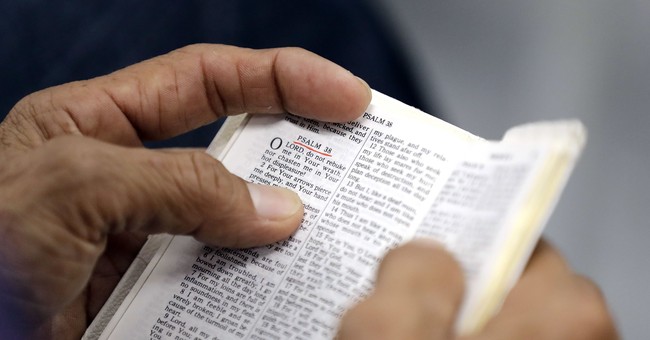
How you answer the question “What would Jesus say about inequality?” depends on how you define the “words of Jesus.” Many “scholars” limit them to no more than “Love your neighbor as yourself.” Others include only the quotations in the Gospels attributed to Jesus. Most Christians see the entire Bible as the words of Jesus because, being God, he wrote it.
Let’s start with the Gospel quotations. One passage that comes close to dealing with inequality is the parable of the Ten Talents (Matthew 25:14-30). In it, a rich man gave one servant five bags of gold, one two bags, and the third got one bag of gold to invest, “each according to his ability.” Jesus recognized that different abilities will result in different outcomes, although he is vague about the rewards they receive.
The Christian Origins Of Austrian Economics

Economics and religion overlap because both deal with people. Austrian economics is the most Christian of the schools of economics partly because its view of people, time, and money fit Christianity like a glove. This is true, although the greatest economists of the Austrian school in the 20th century -- F.A. Hayek and Ludwig von Mises -- were agnostics. Mises may have become a Christian late in life.
Another argument for the Christian origins of Austrian economics is that the school can trace its genesis back to the Godly theologians associated with the University of Salamanca, Spain, in the 16th and 17th centuries. Church fathers in the early years of Christianity had embraced the economics of Aristotle and Cicero rather than that of the Bible. Their reasons for doing so have been lost, but it may have been due to the tendency of churches suffering persecution to elect young converts from the nobility as bishops because they enjoyed political power. The sons of nobility had a high regard for the great philosophers of antiquity and tended to baptize their economics.
Friday, January 17, 2020
Did Mises Become A Christian?
Having grown up as a Jew in Poland then Vienna at the turn of the last century, Ludwig von Mises, the greatest economist of the 20th century, had every reason to hate Christianity because they had murdered Jews for centuries. But worse for Mises, Christian intellectuals promoted socialism as Godly economics. Mises saw no way to reconcile economics and Christianity, as he wrote in his book Socialism: An Economic and Social Analysis, published in 1922:
The Gospels are not socialistic and not communistic. They are, as we have seen, indifferent to all social questions on the one hand, full of resentment against all property and against all owners on the other. So it is that Christian doctrine, once separated from the context in which Christ preached it—expectation of the imminent
Kingdom of God—can be extremely destructive. Never and nowhere can a system of social ethics embracing social co-operation be built up on a doctrine which prohibits any concern for sustenance and work, while it expresses fierce resentment against the rich, preaches hatred of the family, and advocates voluntary castration…
[Our] evidence leads to the negation of the question asked above: whether it might not be possible to reconcile Christianity with a free social order based on private ownership in the means of production. A living Christianity cannot exist side by side with, and within, Capitalism.
Saturday, December 14, 2019
Tucker Carlson Thinks Business people Are Destroying America

Source: AP Photo/Richard Drew
Fox News’ Tucker Carlson thinks business people are destroying America. He sees the evidence everywhere:
If you’ve spent any time driving around America recently, you may have noticed that an awful lot of the country seems to have shriveled up and died. Take a trip on route two in Maine some time and count the boarded-up paper mills and abandoned houses. Or head down route 23 in Michigan or Ohio and consider the empty factories ringed with barbed wire. Outside the coastal cities, scenes like this are everywhere. Shuttered car dealerships, next to defunct restaurants, across the street from thrift stores and methadone clinics. Community after community, desiccated. Empty husks, with nothing left. Huge swaths of the United States look like this now. What happened?
Democrats Want To Destroy Our Consumer-Planned Economy

Source: AP Photo/Wilfredo Lee
Marx considered profits to be theft by capitalists from their workers. He believed labor alone creates value so workers should get all the profits from their labor and the capitalists should get none. His mind was too weak to grasp the idea that capital is stored labor.
The Democrat party hates profits, too. At least seven Democrat presidential candidates have proposed raising the corporate income tax rate and if the American people would let them, the party would tax away all profits. Non-profits are saintly in their fevered imagination; for-profit companies are the spawn of Satan.
Friday, November 22, 2019
Rubio Needs To Choose Christianity Over Statism
Source: AP Photo/Jacquelyn Martin
At the Federal Trade Commission Building in Washington, D.C. are two large statues titled “Man Controlling Trade.” They were commissioned in the late 1930’s near the height of America’s love affair with socialism and depict muscular men controlling the powerful draft horses of the market for the “common good.”
The myth that the state can control the market and make it produce what bureaucrats want and reward those whom bureaucrats deem worthy is ancient and harder to kill than zombies. Even in the 1930s intelligent people understood that free markets create wealth (reduce poverty) in almost miraculous ways. Marx admitted as much. But markets don’t make everyone equally wealthy, as the envious demand, and they don’t create the utopias of socialist fantasies. Of course, neither does socialism.
So, many people dream of harnessing the wealth generating power of markets to the socialist’s fantasies and having their Kate and Edith, too. The problem is that the power of the market lies in its being free, much as Samson’s strength was in his hair. Markets have always existed. Even the USSR had them. They have rarely been free. Freedom empowered existing markets in China to lift half a billion people from starvation poverty in a single generation.
Subscribe to:
Posts (Atom)