God is a Capitalist

Showing posts with label morality. Show all posts

Wednesday, August 26, 2020

Why Are People Still Socialists?


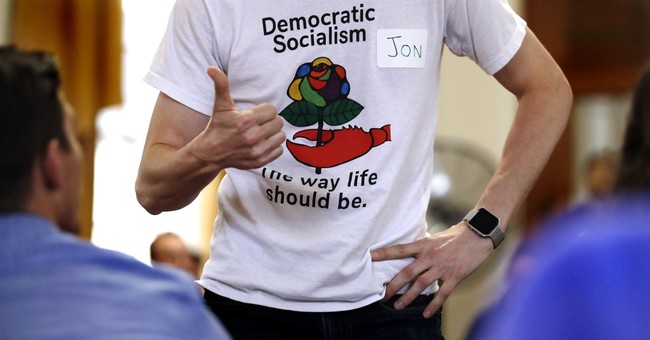
Source: AP Photo/Charles Krupa

As Democrat politicians across the country from mayors to Congressmen and Senators openly demand socialism for the U.S., capitalists should wonder why free market economics hasn’t survived the onslaught of socialism for the past 150 years? Laissez-faire reigned in the Dutch Republic from 1600 until Napoleon crushed it, and it dominated the UK and U.S. throughout the 19th century.

Capitalism has enjoyed brilliant defenders: Frederick Bastiat in France and Francis Wayland in the U.S. as well as the great British and French economists of the 19th century. In the 20th we were blessed with Ludwig von Mises and F.A. Hayek, Milton Friedman, Murray Rothbard and many more. More recently we’ve enjoyed the luminous books of Drs. Thomas Sowell and Walter Williams. All presented overwhelming evidence that socialism impoverishes and brutalizes the people while free markets enrich and liberates. But they have failed to convince a majority.

Why is it that socialism can fail miserably everywhere it has been tried for 150 years and still hold such an attraction for most people? It’s not just the lies that socialists tell, claiming none of those failed attempts were true socialism, that real socialism has never been tried. Intelligent people can see through the lies.

The failure is tactical. Defenders of capitalism have relied on economic consequences to persuade: capitalism works; socialism doesn’t. Socialists have won because they appeal to morality. The great poet T.S. Eliot understood this. Russel Kirk wrote in Eliot and his Age that for Eliot, “Economics must recognize the higher authority of ethics.”

Continue reading the article at Townhall Finance.

Thursday, January 18, 2018

Is the GOP tax plan moral?

Socialists complain that the recent tax reform package passed by Republicans in Congress and lauded by President Trump as America’s Christmas present is immoral because it provides some relief to the wealthy. Behind the complaint lies the offense to socialists that rich people exist at all. Unless a tax plan euthanizes the rich, socialists will consider it immoral.

It’s important to keep in mind that when socialists talk about morality they don’t mean what people have meant for two thousand years. For most of Christian history morality meant those principles that would cause humanity to prosper if we follow them. We got them from God because only our Creator knows what is best for us. Socialists murdered God in the Enlightenment and changed the definition of morality to mean whatever socialists prefer. That is the socialist MO: redefine words so that their arguments win by default.

Tuesday, December 19, 2017

The dismal science gets morality


Several authors want to make an honest woman of dismal science. Among them are Nobel Prize winner George Akerlof and Rachel Kranton who wrote Identity Economics, and Sam Bowles who penned The Moral Economy. Project Syndicate posted a quick review by Ricardo Hausmann who wrote, “Two recent books indicate that a quiet revolution is challenging the foundations of the dismal science, promising radical changes in how we view many aspects of organizations, public policy, and even social life. As with the rise of behavioral economics, this revolution emanates from psychology.”

Cognitive psychology spawned behavioral economics and its proponents have grabbed six Nobel prizes for telling us that humans are not always rational. Behavioral economists tried to corral the older Efficient Market Hypothesis (EMF), which actually said that in the long run professionals make the market behave rationally. EMFers always knew that in the short run people could act irrationally and often did. Behavioral and EMF economists talked past each other for the most part because the first dealt with the short run and the latter with the long run.

The new economics proposed by Akerlof and company want to improve behavioral perspectives by adding morality to the dismal science, which hasn’t been a part of mainstream economics since Adam Smith. Behavioral economics led to calls for the state to nudge people in the direction economists thought best for them,
such as forcing them to opt out of rather than into better choices....The new revolution assumes that when we make choices, we do not merely consider which of the available options we like the most. We are also asking ourselves what we ought to do.”
Akerlof and Kranton propose a simple addition to the conventional economic model of human behavior. Besides the standard selfish elements that define our preferences, they argue that people see themselves as members of “social categories” with which they identify. Each of these social categories – for example, being a Christian, a father, a mason, a neighbor, or a sportsman – has an associated norm or ideal. And, because people derive satisfaction from behaving in accordance with the ideal, they behave not just to acquire, but also to become....In the process, we may understand that we vote because that is what citizens ought to do, and we excel at our jobs because we strive for respect and self-realization, not just a raise.

Thursday, November 30, 2017

Capitalism creates psychos according to professor

Socialists continually flail stuffed monster versions of capitalism they have sewn together from pieces of their fevered imaginations. Usually I just ignore them because their versions of reality are irrational and I don’t want to be the greater fool who debates with a fool. But a recent assault on capitalism caught my attention because it came from the University of Chicago, Hayek’s old haunt.

John Rollert, an adjunct assistant professor of behavioral science at Chicago Booth and in-house ethicist, wrote “The savage ethics of ‘American Psycho’” for the Booth School of Business blog. Now it’s hard enough to get the average US citizen to watch a You-Tube video on economics, let alone read a book. When they do, they often come across nonsense such as this from Rollert:

Friday, March 10, 2017

God is a Capitalist! Markets from Moses to Marx

The PDF version is no longer available because I published the book on Kindle and the contract forbids me to distribute it in any other format. You can find it on Amazon here. However, I will take advantage of Kindle's policy to allow the book from free for five days every 90, so stay tuned.

In his book, Jesus in Beijing, author David Aikman describes a lecture that he attended in Beijing in 2002. The speaker, a scholar from one of China’s premier academic research institutes, the Chinese Academy of Social Sciences, said the following:

One of the things we were asked to look into was what accounted for the success, in fact, the pre-eminence of the West all over the world . . . We studied everything we could from the historical, political, economic, and cultural perspective. At first, we thought it was because you had more powerful guns than we had. Then we thought it was because you had the best political system. Next we focused on your economic system. But in the past twenty years, we have realized that the heart of your culture is your religion: Christianity. That is why the West has been so powerful. The Christian moral foundation of social and cultural life was what made possible the emergence of capitalism and then the successful transition to democratic politics. We don’t have any doubt about this.

Tuesday, October 29, 2013

Questions for Free Market Moralists

All Souls College, University of Oxford, philosopher Amia Srinivasan, wrote in the New York Times Opinionator that defenders of the free market and classical liberalism must answer “yes” to four questions to remain consistent. She thinks her four questions rope and tie free marketeers like a calf in rodeo: if we answer ‘yes’ to all four we prove what disgusting immoral people we are, but if we answer no to any of them then we don’t support free markets. 

However, like most debates with socialists, Amia’s success in roping and tying us free marketeer calves depends upon us accepting her definitions of words and her economic assumptions, which she cleverly keeps hidden from the sleepy rodeo fan. So before I answer her four questions and still maintain that I support free markets, let me clear out some of the manure that people are stepping in. 

First, no one has to accept Rawls’ definition of justice. He spun it and wove it from his own imagination. It’s an interesting one, but that’s all. His entire argument hinges on readers accepting his definition. If we don’t, the rest of his argument collapses. So why did Rawls feel compelled to invent a new definition for justice? Because he didn’t like the results produced by the definition that dominated the West for 300 years.